

More than half of the 70 million Medicaid members in the United States will experience an unmet health related social need (“HRSN”) in their lifetime. The last decade saw innovative companies like UniteUs and FindHelp work tirelessly to solve these unmet needs, but companies still openly struggled with adoption and measurement of their impact. The first generation of social determinants companies helped establish the critical data, referral, and service-delivery infrastructure for this work, but new companies must meet a higher operating bar.
It’s not a question of whether addressing social needs, like stabilizing housing-insecure populations, will impact downstream healthcare costs; there is ample research demonstrating the savings. Buyers increasingly need interventions that are measurable, repeatable, and tied to durable reimbursement or financial outcomes (e.g., recent studies show $85 PMPM, up to $617 PMPM in certain populations). New artificial intelligence (“AI”) enabled social care companies are taking shape, and we expect the next ten years to look much different than the previous decade.
In this piece, we cover:
- The Important Initiatives Happening in 2026
- Funding Data for H1 2026
- The HRSN Market Landscape
- Important Business Models, and What Makes Them “Durable”
- Where AI Is Poised to Create Value
Takeaways:
- Current market conditions are challenging, which creates an opening for the next generation of durable HRSN companies to be built. Startup scale will be achieved through a combination of measurable outcomes, repeatable, AI-enabled operations, and margin improvement.
- Risk is shifting from risk-bearing entities (such as payers and states) to manage costs and improve outcomes, and novel payment and contracting can create a form of “durable” path to scale for startups
- We see four primary categories of startup opportunity: Benefits navigation; Patient advocacy and engagement; Novel outcome-based contracting, with housing stabilization as the clearest current example; Data and AI enablement infrastructure
The Big “Durable” Opportunity
Since the passing of H.R.1, previously dubbed the “One Big Beautiful Bill Act,” markets for managed Medicaid braced for impact as the estimated $911 billion in federal Medicaid funding cuts were announced and began flowing through the healthcare system. The policy environment has created new pressure across managed care, providers, community based organizations (“CBOs”), and state agencies to identify investments that can demonstrate clear return on investment.
Initially, managed care organizations (“MCOs”) like Centene moved, followed by broader healthcare stocks, as the repricing of the managed care sector happened over the following months. We saw devastating blows to government social care programs over the summer, as the impact permeated the system, but suddenly, and then all at once, the market began to climb back.
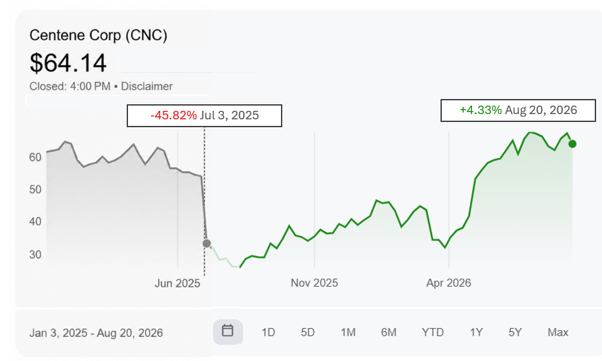
The immediate market reaction, however, matters less than the longer-term shift: Medicaid stakeholders are now operating in an environment of tighter budgets and heightened scrutiny of spending.
MCOs, providers, CBOs, and state agencies are now seeking to identify high-ROI investments to protect margin, which creates a higher bar for HRSN solutions. It is no longer enough to identify a need or facilitate a referral. Successful companies need to help customers connect interventions to utilization, outcomes, cost reduction, or margin improvement.
Medicaid stakeholders are now operating in an environment of tighter budgets and heightened scrutiny of spending.
In response to changing market dynamics, we expect MCOs to continue shifting forms of “risk” to alternative partners, and more aggressively renegotiating rates with state Medicaid agencies. Those state agencies, in turn, respond by continuing to re-engineer eligibility and enrollment technology.
Where previous startups (such as UniteUs, FoodSmart, CityBlock, and FindHelp) found their footing on strong data and referral networks, foundational SDOH companies were built in the 2010-2025 period as social determinants of health were at the forefront. These businesses helped prove demand and build critical infrastructure, but many models relied heavily on government grants/regulatory support or referral-driven workflows without a clear path to consistently measurable outcomes.
The opportunity today is not merely better “access” to information; it is using data and workflows to get people to the right intervention at the right time. AI becomes a natural enabler in this environment, not simply because it is new, but because it can lower the cost of operating and personalizing care models.
“Hard times” breed creativity and resilience. As Medicaid budgets tighten and stakeholders focus more intensely on measurable margin improvement, we expect a new generation of category-leading HRSN companies to emerge. Further, as the AI infrastructure continues to be built, we believe the opportunity is likely to be most visible in benefits navigation; patient advocacy and engagement; novel outcome-based contracting, including housing stabilization; and data and AI enablement infrastructure, which we spotlight below.
Important Initiatives Happening in 2026
Six important pillars serve as the foundation of health for low-income Americans: food, housing, transportation, social support, environment, and health literacy. Coinciding with the release of the Accountable Health Communities (“AHC”) model in 2016, Centers for Medicare and Medicaid (“CMS”) established the term Health Related Social Needs (“HRSN”) in an effort to describe the individual-level impacts of social factors.
In 2026, CMS and the innovation arm, Centers for Medicare and Medicaid Innovation (“CMMI”) are supporting startups to test the ability to deliver high quality care at a low cost through models, which serves as a strong market signal for innovation in social care.
Most notably, their recent model ACCESS, represents the system’s desire to act on three conditions that make this moment different from prior attempt: First, the scale of unmet need is not abstract; it shows up in avoidable ED visits, uncontrolled blood pressure, and members cycling in and out of the system without ever getting stable. Second, AI now makes it a possibility to reach those members at a fraction of the cost of previous care delivery, enabling economies of scale when leveraging technology. Third, ACCESS ties payment to outcomes, rather than activities, thus creating a financial structure that rewards getting members healthy, not just getting them “seen” within the system.
Jacob Shiff, Chief AI and Technology Officer of CMMI, has publicly expressed this focus on outcomes and how it will inevitably push startups serving Medicare and Medicaid members to focus more on HRSN. Health plan executives are also seeing an increased focus on social needs.
“Addressing social needs is becoming the minimum expectation for vendors addressing any condition in Medicaid” – Yara Elbeshbhishi at CareFirst BlueCross BlueShield Community Health Plan Maryland (CareFirst CHPMD)
ACCESS recently announced applicants across the digital health ecosystem, rewards low-cost scalable care such as AI and if expanded to Medicaid, as Chrissy Farr and Alexa Mikhail highlight, could be momentous. The reality thus far is to start innovation with Medicare.
With this in mind, we’ve highlighted a few government and policy signals worth watching, along with noteworthy public-private partnership announcements. Perhaps most surprising, one of the most “active” new entrants is Anthropic, whose aspirations continue to lean towards an active role in public health initiatives domestically in the United States and globally.
Government and policy resources:
- Waivers: CMS funding pathways for HRSN, Section 1115 waivers renew state-by-state on a four year period, and In Lieu of Services (“ILOS”), which allow MCOs to offer medically appropriate, cost-effective alternatives to clinical care. Important state renewals, such as Colorado and New York, will set precedent for future renewals.
- Agency Adoption: federal healthcare AI is actively being deployed within the HHS, and with AI usage surging, the NIH has become the center of gravity with a 51% increase in from FY2024 to FY2025.
- Price Transparency: HHS continues to publish Medicaid provider spending data, offering a public view of where Medicaid dollars by service and the raw material for payment integrity work. Medicaid HCPCS data here.
Public-private partnerships:
- Maryland: The state announced a partnership with Anthropic to overhaul their government benefit service deployments.
- California: Medi-Cal announced collaborations with Pair Team to build an AI benefits navigator for California.
- Public Benefit Innovation Fund: launched their second $10M fund to accelerate early bets and prototypes in this space. The first cohort awarded seven organizations in 2025 and results will play out over the next several years.
- Anthropic appears to be the most focused frontier AI lab, between them and OpenAI, as they continue to hire startup leaders from social safety net startups, announcing fellowship opportunities to promote benefits navigation, adding public health data to their Claude connector directory, and partnering with Code for America to build AI tools for government, starting with SNAP.
Startup Funding Data in 1H26
Over the past decade, we have seen increased attention and funding go towards social care startups, but data in recent months paints a more complex picture for 2026. Less funding overall, coupled with large institutional financing announcements and liquidity events.
In our Flare Capital Partner’s analysis of H1 private funding data, our estimate for the first half of 2026 companies specifically targeting HRSN and social care needs, together, raised a cumulative $262 million in funding across 19 deals.
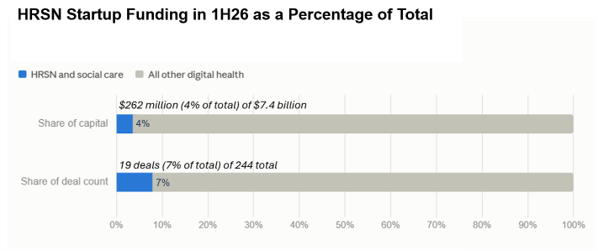
This represents roughly 4% of the total digital health funding, with digital health companies raising $7.4 billion across 244 deals in the first half of 2026, per Rock Health. We know that the majority of investment in overall funding is heavily driven by artificial intelligence, and notably, 10 of the 19 (53%) HRSN and social care companies include “AI” in their company positioning.
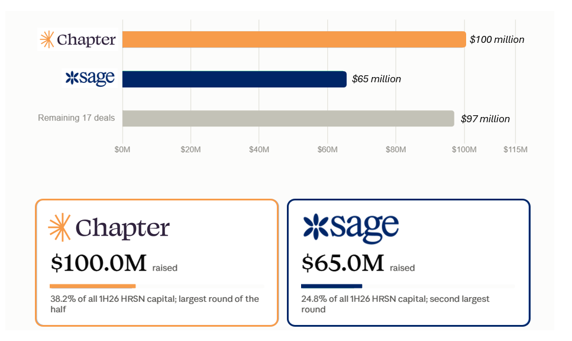
On the exits and liquidity front, TPG’s Rise Fund, the world’s largest institutional impact investment fund vehicle, invested $250 million in FindHelp, representing both an important financing and potential liquidity signal for early SDOH investors seeking to recap positions that have been held since the early 2010’s. Even more recently, in August, Cityblock Health announced both their expansion into North Carolina, along with the coinciding $116 million Series E fundraise and purchase of Homeward Health.
Looking ahead, we would expect both the overall percentage of venture funding (4% of total) and on an absolute volume basis (7% of total) to remain consistent through year-end, as health plans and MCOs continue to lean into technology investment for AI-native services, and as state budgets begin to stabilize.
The HRSN Landscape
The market today is concentrated around high-need verticals that sit on top of what we view as necessary platform functionality. Increasingly, companies in the Medicaid space are starting with point-solution wedges before expanding toward infrastructure that connects more deeply into payer workflows. The map below highlights private companies operating across key social-needs verticals, as well as the infrastructure layer beneath them.
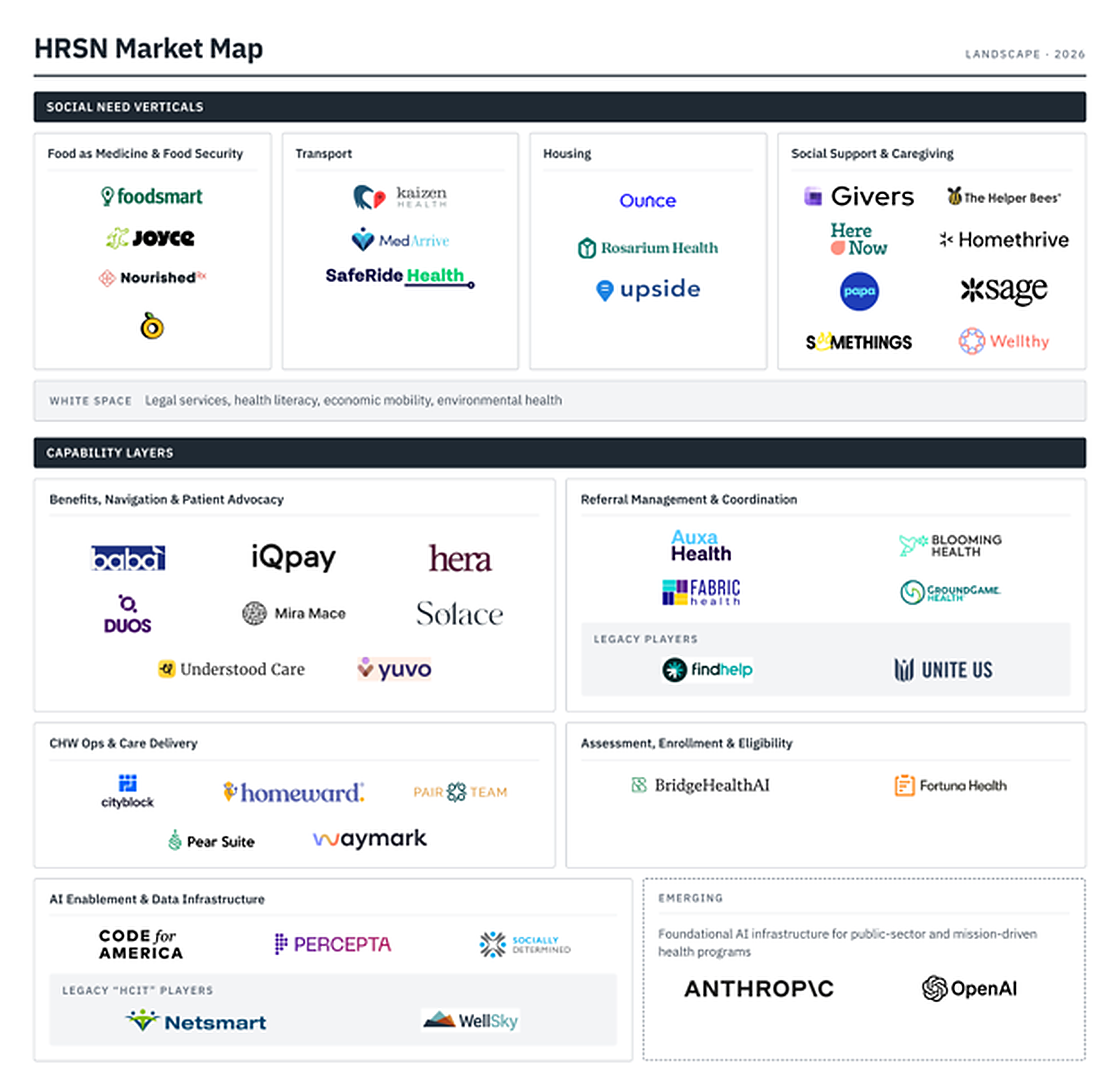
FindHelp and UniteUs are two of the largest companies operating in the market, both focused on closed-loop referrals between payers, health systems, and community based organizations but have evolved to promote. Technology and policy shifts outlined throughout this article create opportunities for their businesses to expand and grow margins. However, beyond closed-loop referrals, there is significant white space and opportunity across several other areas of the market.
In our view, the “emerging” categories with clear opportunity for scale include:
- Housing: Housing infrastructure is a bedrock for building upon social determinants of health; Housing instability is also one of the most well-documented root causes of preventable medical spending in the United States. The lack of stable housing leads to at times months-long hospital stays. Individuals facing housing insecurity experience higher ratesof emergency department use, preventable admissions, and gaps in care that compound over time. A recent study in Health Affairs also found that housing support saved $3,260 (roughly $271 per member per month) over a 12-month period, which represents a sizeable opportunity for companies that can execute on achieving key outcomes. Flare Capital Partners is an investor in critical components of this infrastructure, including those like Upside, Rosarium, and Ounce.
- Benefits, Navigation & Patient Advocacy: MCOs and states require infrastructure, payment, and administrative support to deploy local benefits such as food, diapers, etc. A new vertical around Principal Illness Navigation (PIN) reimbursement has emerged quickly and is gaining momentum around patient advocacy and benefit navigation, targeting MA, Medicaid and SNP populations. We expect this category to rapidly expand as companies layer on technology and services, such as behavioral health, as we know that over half of the 70 million Americans on Medicare carry a basic unmet need, and 38.6% have at least one behavioral health need. While we merged benefits navigation and patient advocacy and engagement for the market map, we see them being two unique opportunities in the next wave of HRSN startups. Leaders in this space: Solace; emerging companies include: Baba, Understood Care, Mira Mace, and Hera.
- Assessment, Enrollment, & Eligibility: Most people who qualify for benefits never enroll. Among those who do, many lose coverage at renewal not because they’re ineligible, but because the paperwork is too hard. Companies here are building the infrastructure to identify who qualifies, move them through the process, and keep them covered. Leaders in this space include tech- and AI-enabled companies Fortuna Health and BridgeHealthAI.
- AI Enablement & Data Infrastructure: The demand for real-time, rich data sources to really understand the user is high. The social care data infrastructure remains just as important and is an overlooked opportunity in our space. This can be hamstrung by health plans and state agencies that lack real infrastructure that is ready to adopt solutions. It requires innovative strategies in data ingestion, data interoperability, and communication.
In the white space section, we highlight a few cross-sectoral and public health level initiatives that still deserve attention. Examples include, legal support for incarcerated adults, economic mobility opportunities for young Americans, and environmental home health products particularly for individuals in temporary or subsidized housing.
Anthropic and OpenAI continue to announce initiatives around the modernization of the social safety net. They’ve hired leaders at civic technology companies and have initiated partnerships with states to begin exploring solutions to improve eligibility screening and enrollment processes. It will be interesting to see how frontier lab involvement evolves, and whether a move to acquire a legacy player like a UniteUs or FindHelp could accelerate the ability to make use of AI infrastructure and integration with state safety net programs.
Other segments of the market outlined in our market map include:
- Transportation: Enabling patients to get to important appointments or to simply run errands particularly in more rural areas, can make a significant impact on adherence to treatment plans for high-cost conditions. A CMMI employee disclosed that transportation is a major concern for medicaid populations that startups should be addressing. Companies include Saferide and Kaizen.
- Food as Medicine: Food as medicine and medically tailored meals became more popular among payers over the past several years. Ensuring patients are food secure and eating healthy (in accordance with relevant diagnoses) which can lead to significant reductions in total cost of care, though many of these companies struggle to expand beyond potentially brittle supplemental benefit budgets, which continue to fall under pressure.
- Social Support and Caregiving: Particularly for dual-eligible/D-SNP patients, social support and caregiving can enable at-home care for aging or disabled populations, which can relieve some of the burden placed on family and friends. Companies include Papa, Givers, and Sage, among others.
- Referral Management and Coordination: In order to properly reap the benefits of social care, patients need to be properly navigated to the right care (often administered by community-based organizations). Historical category leaders include: FindHelp, UniteUs.
- Community Health Worker Ops and Care Delivery: CHWs often need management software to track the patients they care for and ensure they’re shepherding them to the right care; separately, care delivery companies focused on Medicaid population often employ CHWs to support their patients. Companies include Pair Team and Pear Suite.
Important Business Models, and What Makes them “Durable”
We asked every interviewee their perspective on business models, who the primary (and best) buyers are, and how to navigate these different models. The results were nuanced. We’ve broken out the various business models below in an attempt to create a comprehensive set of options, but in summary, our emerging view is that there needs to be engagement across risk-baring entities, states, and community organizations to be successful.Startups that can demonstrate outcomes, but also can create novel contracting structures with risk-baring entities, will create a wedge and a “durable” moat that ideally incentivizes both (or all) parties involved.
“PEMPM is the cleanest near-term contracting method. It’s familiar to health plans and unlocks possible movement toward milestone-based contracting as ROI tracking along a continuum of progress becomes more standardized or more accepted.” – Jake Rothstein, CEO of Upside
We’ve outlined a number of core business models, which is non-exhaustive, but represents a snapshot of the various contracting structures or approaches companies are taking that can enable distribution and growth:
- PMPM / PEMPM: Fixed monthly payment, either per eligible member or per engaged member. Most natural fit for MCOs and health plans because it supports predictable budgeting. Requires sufficient confidence in outcomes and clear definitions for the eligible population, attribution, engagement, and performance expectations. Upside is a useful example of a model built around housing stabilization and health-plan contracting.
- Performance-based / shared savings / rev-share: Payment linked to agreed outcomes, savings, or revenue, which is usually the hardest model to contract early because measurement, attribution, and retrospective reconciliation can be contentious. Expect longer contracting cycles, but high potential upside. Often best layered on top of a PMPM or case-rate base payment, rather than serving as the entire revenue model from day one.
- Outcomes-based: Payment tied to closing referral loops, completing an application or enrollment, engaging a member, reducing avoidable utilization, or achieving another agreed workflow or outcome metric. This is especially relevant for AI-enabled tools going forward, where buyers increasingly expect value to be tied to action or results rather than access to a dashboard alone.
- Delegated services / embedded care team: A health plan, provider, or CBO pays a company to operate a defined function, such as outreach, navigation, community health worker support, housing stabilization, or closed-loop referrals. This can resemble a managed-services contract, with staffing and operational capacity as the core product. It may be a practical early model before a company earns enough trust to move toward PMPM or outcomes-based payments.
- Enterprise license + implementation / data fees: Annual or multi-year software contract, often accompanied by implementation, integration, analytics, data-access, or configuration fees. Examples include enterprise referral-network and resource-navigation platforms such as Unite Us and Findhelp.
- Software plus services: A platform license paired with implementation, outreach, navigation, reporting, or operational support. This hybrid model may be particularly important in HRSN because software alone does not ensure that a member reaches, enrolls in, or uses the underlying service.
“Emerging” Models Seeing Rapid Adoption / Scale:
- PIN / CHI billing: CMS introduced Community Health Integration (CHI”) and Principal Illness Navigation codes (“PIN”) in 2024, turning advocacy from a cash-pay or philanthropic service into a directly billable healthcare category. Capital has followed suit: Solace Health raised a $130 million Series C at a >$1.0 billion valuation, demonstrating the category’s first venture-scale outcome.
- Usage-based AI & data infrastructure for model post-training: Charges based on API calls, data volume, users, workflow volume, completed tasks, or agent actions within an existing system. This is an emerging model for AI infrastructure companies, but it will need to prove that usage maps to real operational value rather than simply more queries or automated activity.
There are several challenges facing sustainable business models: savings can go into a different bank account; MCO member churn is 12-18 months; programs are administered on the local state level, not federal level; and measuring HRSN intervention attribution is very challenging. When thinking about customers, it’s important to identify the customer you can show immediate value to. Find the advocate that cares most about the measurable outcome you’re confident you can impact.
“If you can find an intervention with a relatively short ROI, the MCOs are the place to be…they’re the payer and they’ll reap the benefit…But the real challenge is finding what that ROI is, and then finding a state convinced that HRSN belongs in the Medicaid bucket. Not everybody believes that.” – Dr. Rochelle Walensky, 19th director of the U.S. Centers for Disease Control and Prevention and Flare Capital Partners Executive Partner
For most HRSN categories, contracting can stall with a response around “probably, eventually, under the right attribution model,” but it’s hard to track what patients actually need or receive due to unstructured and data restrictions to support closed loop referrals. For example, Z-code capture in the EHR sits around 1.2% of patients with a documented social need, even though unstructured notes do capture information for a much greater portion of patients. Some social needs like housing are more reliably reported than more nuanced needs such as health literacy.
The barriers exist on the assessment side: there’s not one agreed upon social needs assessment and providers feel strapped for time or don’t ask because there aren’t great solutions when a need is identified. These problems present new opportunities for companies like Pair Team, BridgeHealthAI, Fortuna, and Pear Suite to deliver AI-native data tracking that can inform future engagement.
Two CEOs that we interviewed described this well:
“Social care is still all about caring for someone’s social needs… but it drives engagement. And if it’s driving engagement, then you can build out real risk signals that will drive more confidence in taking on value-based arrangements.” – Neil Batlivala, CEO of Pair Team
“The wedge we’re taking today is in areas that have real financial ROI today…screenings, redeterminations, insurance coverage…Once the patients are engaged with us, now we can do the rest of it.” – Jinal Shah, CEO of BridgeHealthAI
Products that can identify what the user really needs and can directly address it at the user’s health literacy level are the ones with a real shot at building a channel. We spoke to Chethan Bachireddy former Chief Medical Officer at Virginia Medicaid about addressing needs, who shared:
“Food insecurity is often episodic, not constant. A hallmark of poverty is instability and uncertainty. People can move in and out of periods of heightened need, and knowing when someone is at risk of eviction or running out of food is critical to deploying the right intervention at the right time. If we treat social risk as static, rather than dynamic, we’re going to miss key opportunities for effective intervention and support.” – Chethan Bachireddy, former Chief Medical Officer of Virginia Medicaid
Where AI is Poised to Create Value
In a space where the margin is tight and the population is often overlooked, AI could be poised to make a significant impact.
We expect startups to take a more vertically-integrated approach to technology over time in order to capture more dollars and make use of unstructured and siloed data. We also expect the buildout of conversational agents that can bridge the gap between clinical “jargon” and low-health literacy to create opportunities, as more mature prediction and resource mapping models emerge.
“What’s interesting about AI is its ability to sneak its way into the existing workflow. Engage with patients in more natural ways. Understand them in a more holistic context. And be a good navigator and matcher of patient to service,” – Will Stokes, investor at Town Hall and Co-Founder & former Chief Growth & Performance Officer of Strive Health
Hirsh Jain, CEO of Percepta, an AI transformation company focused on supporting the advancement of government and healthcare, shared his view on AI advancements.
“Novel consumer experiences can change underlying behaviors. Outside of ChatGPT and Claude, there hasn’t been a truly viral consumer AI experience, particularly for underserved populations. What we need at a patient level in healthcare is behavior change. There is a huge opportunity to build a personalized healthcare experience that is still, for me, a UX problem.” – Hirsh Jain, CEO of Percepta
While the opportunity is attractive to leverage AI to solve problems and a lower margin, bias lives in the data AI is being fed, and must be intentionally considered for any company building for this population. When speaking to Sheila Yahyazadeh, Chief External Operations Officer of CareFirst CHPMD about the remaining gaps to be filled by AI in HRSN, she urged:
“If you’re going to focus on maternity, you’ve got to call out the elephant in the room. There’s an inevitable bias in what’s happening and that’s resulting in poor maternal outcomes. Can AI help reverse the bias? All of the solutions I’ve seen are based on biased data…So what are we doing about it?” – Sheila Yahyazadeh, Chief External Operations Officer of CareFirst CHPMD
Consumer-facing benefits tools are intriguing, especially in context of the work that OpenAI and Anthropic are both doing with nonprofit organizations, though, this is likely more of an open source tool (e.g., My Friend Ben) as the economics alone might not support a large standalone business.
Our view is that AI may unlock novel forms of multimodal data, focusing on the context around point-of-care interactions that will create social “intelligence” data that will be critical to voice and chat models that seek to close gaps.
Conclusion
Taken together, today’s market conditions are challenging, but they may also create the opening for the next generation of durable HRSN companies. As risk-bearing entities face growing pressure to manage costs and improve outcomes, the startups that scale will be those that can prove measurable ROI, develop true AI-native workflows, and support margin improvement across constrained healthcare budgets.
We see the clearest opportunities emerging across four categories: benefits navigation, patient advocacy and engagement, novel outcomes-based contracting, with housing stabilization as the clearest current example, and the data and AI infrastructure required to make social care reimbursable, measurable, and repeatable.
If the first wave of social care was built on political momentum and referral infrastructure, the next wave will be built on durable business models that can survive any administration and become core infrastructure for total cost of care management.
Note: Flare Capital Partners is an investor in companies relevant to the themes discussed (e.g., companies such as BridgeHealth, Joyce Health, Ounce, Pear Suite, Rosarium, Upside).